
Latest News + Hitchhiker Blog

Interlibrary Loan Newsletter #7 – 2025 Year in Review

Interlibrary Loan 2025 Year in Review by Amy DiBello

Interlibrary loan activities in 2025 were fascinating and enlightening. It has been a pleasure to serve our rural and tribal libraries, state employees, museums, and correctional facilities. Traveling with our Outreach Librarian Jennifer Finley-McGill, who works with The Library for the Blind and Print Disabled allowed us to let libraries know about interlibrary and print-disabled services. We met dedicated librarians, library volunteers, and community members who support their communities beyond just running their libraries. They supply food banks, seed libraries, and assist their patrons with telehealth, digital literacy, and creative, uplifting programs for all ages. New Mexico libraries and artists have a special collaboration with libraries hosting art display and artists contributing a percentage of their proceeds to funding libraries. 
One of the most profound experiences I had this year was visiting the New Mexico State Penitentiary with volunteers from the Santa Fe Public Library a Summer Reading Kickoff Event. The Santa Fe Public librarians hosted fun activities including art bingo, Pictionary, and a book raffle. I shared information about The New Mexico State Library’s collections, ILL services, and Museum passes. The New Mexico State Library Public Services Bureau and The New Mexico Department of Corrections are fulfilling an interagency agreement to enhance existing library services for inmates and provide interlibrary loan services to inmates. NMDOC educators, librarians, and directors focus on successful reentry for inmates and programs that include rehabilitation and career pathways. We got a tour of the facility’s barbershop and podcasting studio where Inside Voices is recorded.

This year, I had an excellent Zoom training session with correctional librarians from across the state about our Interlibrary and Articles Plus procedures and got to meet librarians I have mainly communicated with through phone or email. One of my goals for the new year is to visit as many prisons as possible to learn about their libraries and educational objectives. Deputy Education Administrator Robert Madrid has been helpful with introducing me to librarians facilitating meetings for the Public Services Bureau.

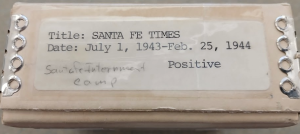
Interlibrary loan lending has increased this year, and we are flattered that so many libraries and universities on the East Coast are requesting books from our Library and Information Science and Southwest collections. The most interesting interlibrary loan request I received this year came from a university in Maine for a digitized copy of a special newspaper. The New Mexico State Library is the only library in the United States that has a copy of The Santa Fe Times, or in Japanese, Santa Fē jihō on microfilm. Fulfilling this interlibrary loan request took some teamwork. I couldn’t find the microfilm in the cabinets, but our Government Documents librarian Susanne Caro found it in the Southwest collection, since the history of the Santa Fe internment camp is a part of New Mexico history. Susanne digitized the entire reel of film, and I created a new LibGuide, to alleviate the difficulties of sending every scan to the researcher.  The microfilm was then entrusted to our Southwest librarian, Marcy Botwick.

The Santa Fe Japanese internment camp was opened in February 1942 and closed in September 1946. Over 4,500 men of Japanese descent passed through the camp in the aftermath of the Pearl Harbor attack. Conditions were harsh, overcrowded, and highly regimented. The men filled the jobs required to keep the camp running, including running the mess hall, camp hospital, and farm. Mail was a lifeline for the prisoners, although incoming and outgoing mail was censored. Inmates created a daily one-sheet newspaper called the Santa Fe Jihō , beginning with their first issues dated July 1, 1943, and each article had to be approved by censors.

The last internees left in May 1946 and in the 1950’s the Casa Solana Subdivision was constructed, erasing every trace of the camp. A rock marker with a bronze plaque was dedicated on April 20, 2002. The monument is on a hill in Frank Ortiz Park. The plaque reads: “At this site, due east and below the hill, 4,555 men of Japanese ancestry were incarcerated in a Department of Justice Internment Camp from March 1942 to April 1946. Most were excluded by law from becoming United States citizens and were removed primarily from the West Coast and Hawaii.  During World War II, their loyalty to the United States was questioned. Many of the men held here without due process were longtime resident religious leaders, businessmen, teachers, fishermen, farmers, and others. No person of Japanese ancestry in the U.S. was ever charged or convicted of espionage throughout the course of the war.  Many of the internees had relatives who served with distinction in the American Armed Forces in Europe and in the Pacific.  This marker is placed here as a reminder that history is a valuable teacher only if we do not forget our past.”